}

Villager Expat

Expat Greenwich Villager, chasing the rents in Manhattan. Engrossed in a blog-to-book project about my city ancestors. Everyday I'm amazed by what I find on Ancestry and in old newspapers.

November 24, 2025

Remembering A. Fitz & Sons butchers on First Avenue, 1987


A. Fitz & Sons meat market and Pescatore Seafood were neighbors for many years on First Ave., at the corner of 52nd Street. Greta Garbo and Katherine Hepburn shopped there.


Midtown butcher, 1987 painting of A. Fitz & Sons, est. 1867
© Barbara Boyd Carter / Artists Rights Society (ARS), New York

Butcher David Adams and, on the phone in the back, Selma Schwartz, granddaughter of founder Abraham Fitz. In 1992 the business was sold to Simchick Meats & Poultry, now located at 988 First Ave., bet. 54th/55th streets.

My mother composed her large watercolor and pastel in her Beekman Place apartment from on-site sketches and photos she took for reference. 


In November 2022, the painting came up on #ArtOnLink in Times Square.

This year I posted this painting and others on my apartment door for Thanksgiving.


Contact: Debbie Carter, VillagerExpat@aol.com, (212) 925-3721, and more paintings from her "Midtown Merchants" series at BarbaraBoydCarter.com


October 19, 2025

My mother's work as an art student at Carnegie Tech in the early 1950s.


When my mother was living in  Morewood Gardens in the early 50s, she woke up to an inch of soot on her windowsill every morning.


In her dorm room, 1950s
© Barbara Boyd Carter /
Artists Rights Society (ARS), New York
Almost midnight, the artist at work with a quill or brush, posing with a cigarette holder for dramatic effect when she liked her Camels straight, a second cigarette in hand, objects and the photo with my dad arranged as a still life. She didn't paint this way. She always rendered pictures on an easel or a board in her lap. 


In her senior year, with my dad away at Fort Bragg, she turned serious about her art. 

For a "House Analysis" project, she went sketching in Oakland. One day, when absorbed in her sketching, a cinderblock landed at her feet, thrown from a bridge.

House Analysis, a printer's guide, 1954, Barbara Boyd Carter

"The places I used to go!"

artist reference photo

Page 2 of "House Analysis"

House Analysis, a printer's guide (pg. 2), 1954, Barbara Boyd Carter

She did this casein of the College Club, formerly the Farrell/Bailey mansion, at 143 No. Craig Street, a few years before it was demolished. I'm looking for a public space for this painting where it will be preserved for years to come.

House in Oakland, Barbara Boyd Carter, 1954
© Barbara Boyd Carter /
Artists Rights Society (ARS), New York

The house appears in a Clyde Hare photo from 1953, to the right of St. Paul's Cathedral.

(Overview: View of Oakland with St. Paul’s Cathedral), Clyde Hare, 1953, Carnegie Museum of Art (link)


Contact: Debbie Carter, VillagerExpat@aol.com, (212) 925-3721, full art portfolio at BarbaraBoydCarter.com, Pittsburgh pictures at this link.


May 10, 2025

Chasing the rents on the Upper East Side

This was my parents' neighborhood. I never thought I'd move here but the street has a village-y feel. I found a prewar apartment at tree level with a view of old brownstones of art galleries, practically a whole row of them.


One night I saw them loading large paintings through a second floor window.  


I was living in Northport, Long Island when I saw the listing for this apartment. I wanted to move back to the city but wasn't looking on the Upper East Side. 

August 6, 2023

The Burtises and Leroys drive to Allenhurst to see Sadie's house

Nineteen hundred and twelve was a year of disasters, around the world and at the Jersey Shore. In April Mr. and Mrs. French, two summer residents of Allenhurst, died aboard the Titanic on their voyage home from Italy, and in early July, only three weeks before the hit-and-run between Undertaker Burtis and Sadie Brady at Atlantic Highlands Bridge, the Dunes Hotel burned to the ground. 


Asbury Park Press, 10 Jul 1912


"I want to see where she lives." It was Lizzie's idea, Ginny Burtis's friend, who was in the Burtises' new touring car for a Sunday drive when they were rear-ended by Sadie Brady's party. 

That evening of the same day, a few short hours after the accident, the Burtis son drove his parents, the Leroys and the family dog along Ocean avenue in Allenhurst. It was their second weekend trip to view the devastation of the hotel fire in the crowd of gawkers from all over New Jersey, Philadelphia and New York City. Some were fascinated by the finds of scavengers or "miners" who picked through the debris for trinkets from hotel guests but there was too much traffic to linger. Two full weeks afterwards the scene still looked like a ravaged battlefield.

"Terrible loss," Burtis said as his thoughts jumped to his big beautiful house in Asbury Park, all wood. "Hotels can't be made of wood. Their big kitchens and people smoking. Too risky." 

October 10, 2022

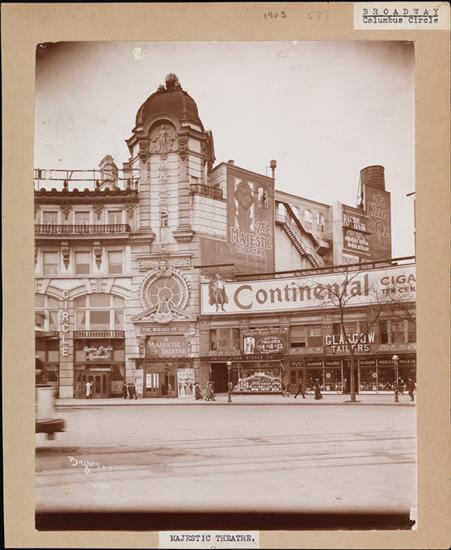
New York City, 1905: Brady v. Brady divorce trial reveals that husband met actress in hotel rooms


The Circle Hotel w/ Robert Burns Cigars ad, top left


Gertrude Mackenzie
in the "Wizard of Oz"
"Miss Mackenzie lived in a suite of rooms at a Columbus Circle hotel and Mr. Brady called frequently there under the name Mr. Burns," Mr. Ordway said.

In 1903 Gertrude Mackenzie appeared as Prince Charming in the "Wizard of Oz" at the Majestic Theatre, now the site of the Time Warner Center.

"Wizard of Oz" on marquee, 1903

In outlining his case to the jury, Sadie's lawyer Samuel H. Ordway said, "We shall show that during last spring and summer Mr. Brady became cold toward his wife and showed attention to an actress by the name of Gertrude Mackenzie, who has taken parts in small comic operas as a flirt, commonly known as a soubrette."

Called as first witness, a maid in the Brady household testified that Mr. Brady packed up his belongings last August and said, "I'm not going to live in this hell-hole any longer!" 

Brady visited Miss Mackenzie at Reisenweber's Hotel in Columbus Circle, giving his name as Mr. Burns. A boy who used to work at the hotel but employed by Sadie's brother Charles Singer at the time of trial . . .

August 12, 2022

1912, Asbury Park, part 3: Burtis finds out who crashed into his auto

Could this be Sadie V. Brady in New York, 1911,
a year before the accident?
(link to clip)

"Take the car back to the garage and get rid of it. 
The brakes don't work," Sadie said to her nephew who was driving their rented auto into Allenhurst along Ocean Avenue. "This is your uncle's fault. If he had let us have his car none of this would have happened."

Her nephew Robert and the chauffeur-chaperone sitting beside him knew Mr. Brady needed his car in New York for business, but they knew better than to argue with Sadie.

This party of three that had rear-ended undertaker Burtis's touring car at the Atlantic Highlands bridge moments ago enjoyed the ocean views and sea breeze along the newly paved boulevard but the accident had spoiled it.

After Robert dropped off his aunt at their cottage
and received instructions not to pay the bill, his chauffeur-chaperone guided him to the garage. Turning right onto Corlies they headed towards Deal Lake passing the Allenhurst Beach club at Norwood Avenue, a block from his aunt's house.


He continued on up to Main Street, where he turned left and proceeded into the unfamiliar territory of the hamlet's utilities district. Robert gripped the wheel as they traveled south past the trolley car barn at Elberon, past the light and waterworks at Hume, and still further south to the garage at Euclid and Main, where Robert told the attendant the brakes didn't work and dropped off the car without paying.

*   *   *

"I don't mind paying when I'm in the wrong," Burtis said to Croce, "but they ran into me. They ruined a new car."

A day after the accident,

April 24, 2022

1912, Asbury Park, part 2: Undertaker Burtis goes for a drive in his new Haynes touring car

Photo: Norah Magrini of Avon Historical Society

"Another unfortunate event," the young reporter said. "But the Haynes got it good this time."

Ralph tipped back his bowler hat and waited. 

"I'm Fredus White from the Press. I wrote about your last accident, on Sylvania Avenue in Avon, in front of Mayor Thomson's garage? I live a block away, at Woodland and Main."

Asbury Park Press, 3 May 1912

"I remember you," Ralph said, annoyed that a reporter who looked the same age acted like he had something. 

March 22, 2022

1912, Asbury Park: Undertaker Burtis goes for a drive in his new Haynes touring car

Atlantic Highlands bridge, early 1900s
Photo: Walt Trevors - Historical Society of Highlands


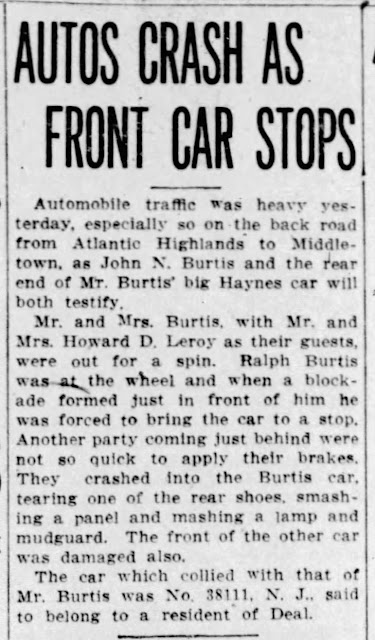
It was a year of disasters, around the world and in Asbury Park. In April two summer residents, Mr and Mrs Herbert French, died aboard the Titanic on their voyage back from a winter in Italy; in early July the Dunes hotel in Allenhurst burned to the ground, and a couple weeks later on a Sunday after church when the Burtises of Asbury Park took their dear friends, Mr and Mrs Howard Leroy, for a scenic drive in their new five-passenger Haynes touring car their delightful ride came to an end on their approach to Highlands bridge.

Asbury Park Press, Mon. July 29, 1912
Page One

Did the other driver leave the scene?

The Haynes was undertaker Burtis's first car, and a keeper. With an Eisemann magneto starter, 40 h.p., a speedometer, windshield and five lamps, advanced design elements at the time that were meant to impress . . .   

April 4, 2021

Grandpa Charley, which Foo are you?

 "Why would you want to live on Waverly Place? It's so old."

My realtor wouldn't be getting her commission. I'd found this apartment on my own. I had told her I liked downtown. I missed my quirky tenement apartment in Soho with the exposed brick and pipes, the view of backyard gardens and old houses, but construction drove me out and I ended up in Murray Hill for three years. It was the end of February when I moved there, to 38th Street. A monster wisteria vine in full bloom filled the picture window. It snaked up a tree in the townhouse garden across the way and was nearly as high as the house. But as time went on, life in my building turned into a co-ed dorm with thirty-somethings who didn't belong in Manhattan. Some say "You can do anything in New York." No, you can't. 

I escaped twice a day downtown to bookstores and my favorite restaurant, Caffe Pane e Cioccolato on Waverly Place. Across the street was a massive apartment building, no. 11. It would be convenient to live there but it too was filled students. I learned that the same landlord had a studio available in a West Village walkup a few blocks over and around the bend at Waverly and 10th Street, on a tree-lined lane catty-corner from a bookstore.


August 7, 2020

"A Chinese divorce": my 2nd great aunt's marriage to her wealthy Chinese husband and her influence


"Chinese Divorce Suit," The Mail (Stockton, CA) 24 Jun 1886, p.2

Years ago in a laundry shop in Paterson, when the city was a prosperous manufacturer of textiles and silk, young and pretty Minnie Kiersted stopped by weekly to drop off her employer's laundry. She caught the eye of Chinese owner Wang Sing Bow, better known as Charley Sing.

In reports of their divorce trial the papers called him "the most successful Chinaman in the City of Churches." On Sundays he dressed in a Prince Albert coat, high silk hat and patent-leather boots, and wore "a locomotive-headlight diamond."

In Minnie's testimony . . .

July 18, 2020

In 1923 in Asbury Park, my Brooklyn grandmother's acting career gets sidetracked by a man

Remember our midnight swim? Love, Ralph

"Did you have to send me that postcard?"

"I thought it was romantic."

"My mother saw it!"

"Don't worry. We're getting married. Everything's alright now." 


It was a moonlit night in April as they drove down Ocean Avenue in his Haynes touring car. Exhilarating! but the racket of spring peepers made it impossible to have a conversation. Her thoughts drifted to talks with her sister Evelyn.

He's a good catch, MariaUndertakers always make a living.

He's not an undertaker! He sells pianos and he's musically inclined.

He's in music for now but he'll take over his father's business someday and you'll live in a mansion. He's your ticket out of Brooklyn. You can't be an actress forever.

June 26, 2020

A stonecutter in the family: the Casper monuments business near Green-Wood Cemetery

G Casper Monumental Work, Lettering Jobbing Etc., 24th n. 4th av, Brooklyn, ca. 1880
Photo ©Cathy Tipton, all rights reserved. Used by permission.

He came from Germany in 1846 when he was 20 and made headstones for a living. His monuments mark the resting places of families in Green-Wood Cemetery with love and respect, and commemorate their lives forever.

How did he become a stonecutter? . . .

June 19, 2020

Walking in their footsteps: my relatives from Brooklyn, known and unknown

Bond trader Frank Carter on Wall Street in the 1930s
He didn't like to talk about his childhood in Brooklyn. As the first in the family to work on Wall Street in the corporate world, clients and peers in his day made assumptions about you by your ethnic background. He was proud of being from Brooklyn. Flatbush was nice then, but his father, a bookbinder, deserted his mother and him by the time he was 13 and my grandfather had to go to work, first part-time as a bellhop in a hotel, then full time after his first year of high school. A serious person and a reader like his mother, he wanted a better life. But at 16, at the start of WWI, a wave of patriotism was sweeping the city. He tried to sign up for the draft by lying about his age but was sent home when his mother showed up. He was the breadwinner in the family. He couldn't go. Back at work, he befriended the Wall Street businessmen who passed through the hotel, found a mentor, and eventually became a bond trader with his own firm at 111 Broadway. Unlike his father, who divorced and remarried twice more, he was a a rock. After familial setbacks, and seeing what could be lost in stock market crashes and wars, . . .

June 12, 2020

From my mother's manuscripts: a 1940's childhood worshipping a teenage aunt, longing for happier days at Lake Hopatcong

Doris at Lake Hopatcong
I was playing across town at Millie's house, where I had followed my aunt Doris. They were playing at the piano with two other teenage girls when all of a sudden they said, "Bobbie, you have to go home. You can't play here anymore."

I wanted to be with Doris constantly. She was sixteen and I was eight, and while she was my dad's younger sister, we had grown up like sisters next door to each other.

I followed Doris and her friends to school. I acted older, copied the way she dressed. It was more exciting to be with them than with third graders. To watch Doris dress for a date was a thrilling experience, like watching a movie star prepare for the cameras. I helped her put on her makeup but the climax was the anointing with perfume. Carefully holding the pink cut-glass bottle in one hand, she adroitly squished the satin-covered rubber ball with the other--squish, squish, squish. Apple Blossom. Soon her small corner bedroom became more heady than the apple orchards across from the fairgrounds. We couldn't breathe, and ran gasping from the room. Doris only laughed. "Well, that'll last through the movie." Especially at the Palace when the famers came to town on Saturday nights. "That's why it's called the horse-opera, Bobbie."

"Why do I have to go home?" I had asked the girls. . . .

April 7, 2020

Indulging in Ancestry while staying at home: the great-grandmother who left England and put me in the U.S.


"Why did she come here?" I asked.

"She had a fight with her boyfriend," my grandmother said. I had asked about her mother who immigrated to the United States from England. I was in love with England. It was 1964 and I'd just seen Mary Poppins. When my mother told me we were English, I was eager to know more about the woman whose picture was on my grandmother's mantel.

"She was a governess," Grandma said. I was filled with visions of a great-grandmother who was like Mary Poppins and had a boyfriend as handsome as Bert and I thought why oh why did she come here only to marry a fireman, have six kids, and live in a small house in New Jersey?

"The English can be mean" was the explanation she gave me, and her cautionary words come back to me whenever I feel myself falling for an English accent or a man in a suit from Savile Row. But they sound like words Beatrice could have said herself. She never went back to England, even to visit relatives.

At a time when many of us are living under stay-at-home orders, I've been on Ancestry everyday marveling at the powerful search engine that instantaneously finds ancestors and official documents about Beatrice.

She came here in 1905 on the Caronia, . . .